



There are a lot of debates going around social media right now about how many midfielders (or none at all) Liverpool need this summer.
The debate also centres around the kind of profile of midfielder Liverpool need.
Is it a destroyer? Someone who eats up space and thwarts opposition attacks? What about a deep-lying playmaker who can slice through opponents with his passing? Or do Liverpool need a bit of both?
The only person who will truly have a clear idea about the answer to that question is Andoni Iraola.
The chances are he won’t be using the same system that he used at Bournemouth at Liverpool. There will be clear differences and he will need to tweak his approach. So, there’s no point drawing similarities or trying to work out who will be his ‘Tyler Adams’ or ‘Eli Junior Kroupi’ at Anfield.
But there is an argument to be made that given the fact that Iraola is going to demand a higher intensity playing style, some of the current midfield profiles in the squad (notably Alexis Mac Allister) may be better off moving on.
If that’s the case, there is also an argument to make that Alex Scott could appear on Liverpool’s radar as a potential replacement.
Scott divides opinions of a lot of Liverpool fans. Particularly because his data at face value does not appear particularly impressive. But this is very easy to overlook if you understand how to interpret data and also the limitations of using data alone.
One of his stand-out traits is how incredibly press resistant he is. It’s what he stood out for while playing at Bristol City in the Championship.
Scott is very comfortable and confident at receiving the ball under pressure in his own half and beating that press to change the game dynamics for his side.
In Iraola’s quick, and direct style of play, Scott has been a key player in instigating transitions and break the opposition’s first line of press.

If you look at this graph here that shows where Scott receives the ball and where he ends his threatening actions, you can see he tends to start his decisive moments in his own half before advancing into dangerous territories in the opposition’s half.
Scott may only rank 12th among midfielders for progressive carries per 90 minutes in the Premier League but where and in what context he is carrying the ball matters.
A progressive carry under pressure is a lot more impressive than a holding midfielder or centre-back running with the ball while being uncontested.
Scott was capable of consistently getting Bournemouth on the front foot under Iraola last season.
His close control, clever ball manipulation and constant scanning allows him to thrive in tight spaces and make split-second decisions that put his team at an advantage.
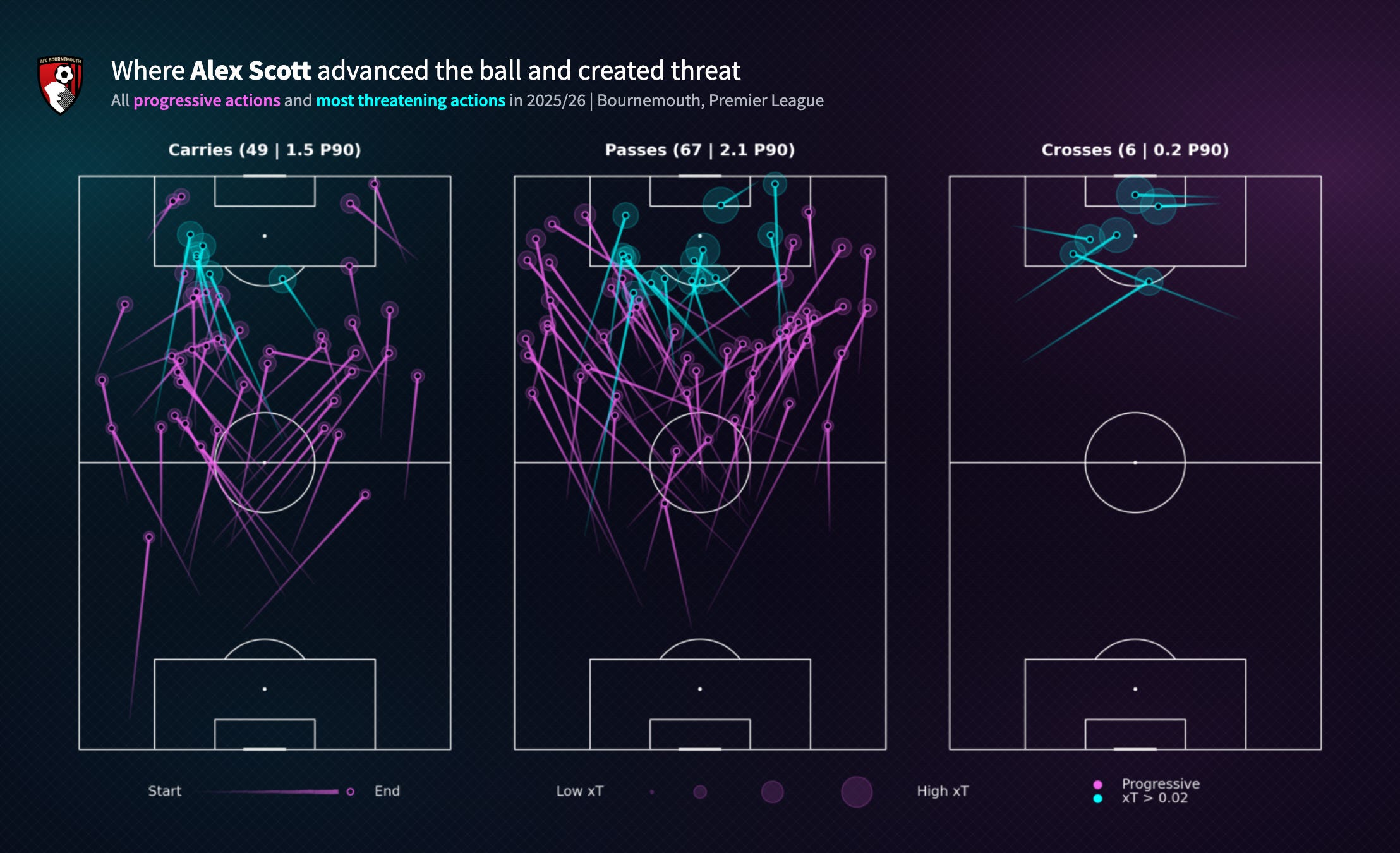
That’s a rare trait, and it’s ideal for Iraola’s football that is reliant on quick and direct players taking risks in order to create overloads in attack.
When he does beat the press, he also makes good decisions on the ball. He likes to take risk, play through balls and make those penetrative passes into the opposition’s final third or penalty area.
Last season no Liverpool midfielder averaged as many through passes (0.70 per 90 minutes) than Scott. He also averaged more passes into the opposition’s final third (5.75 per 90 minutes) than Mac Allister (5.52 per 90 minutes) last season.
He’s everywhere
Now, another massive bonus in Scott’s favour is that he is everywhere.
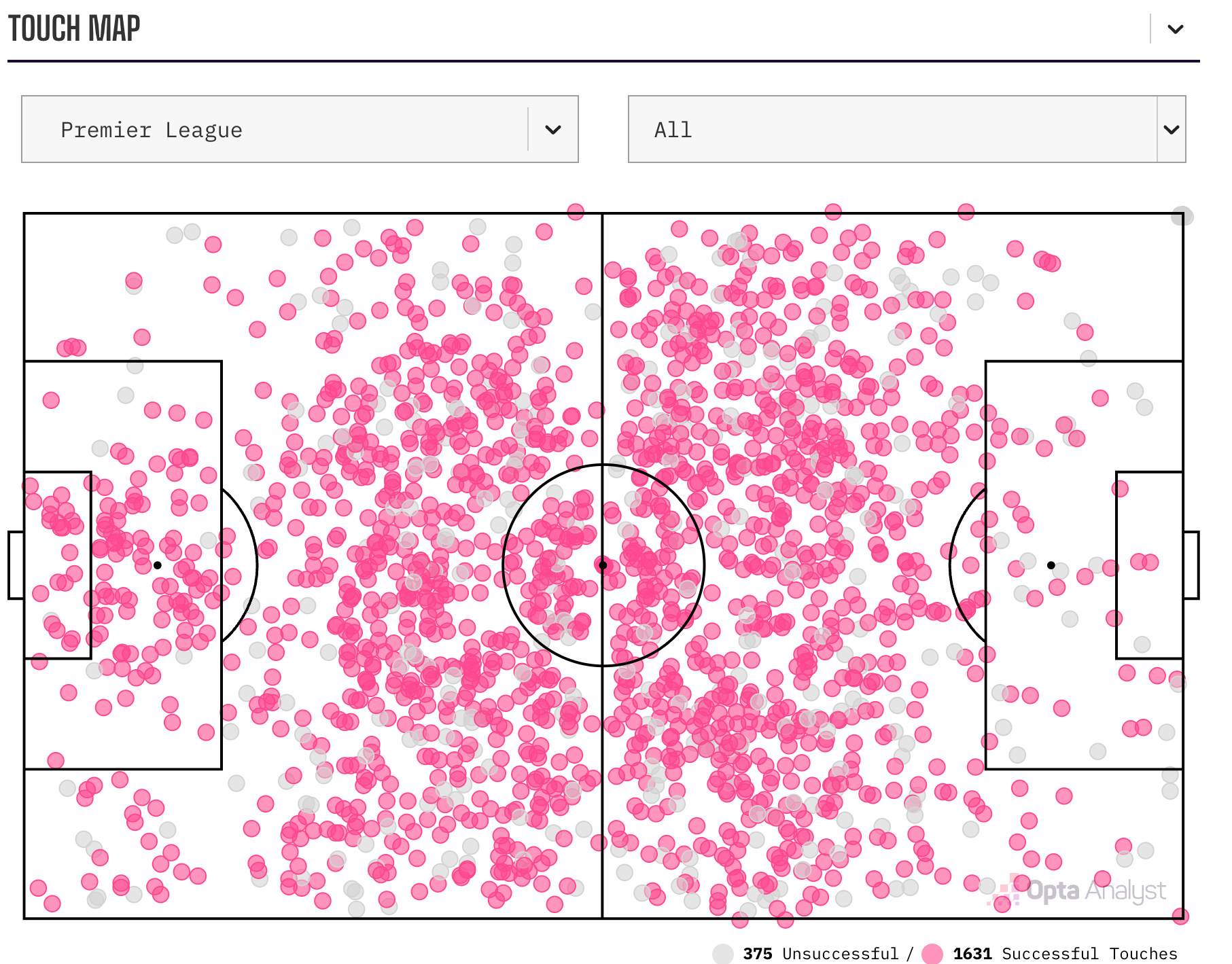
If we take a look at his touchmap below from Opta Analyst you can see that Scott pretty much received the ball all over the pitch for Bournemouth last season.
He is a very energetic player, who will run up and down the pitch and look to defend and support the team in transitions.
Scoutlab’s graphic below also shows the amount of defensive work-rate Scott puts in, and again his actions are all over the pitch.
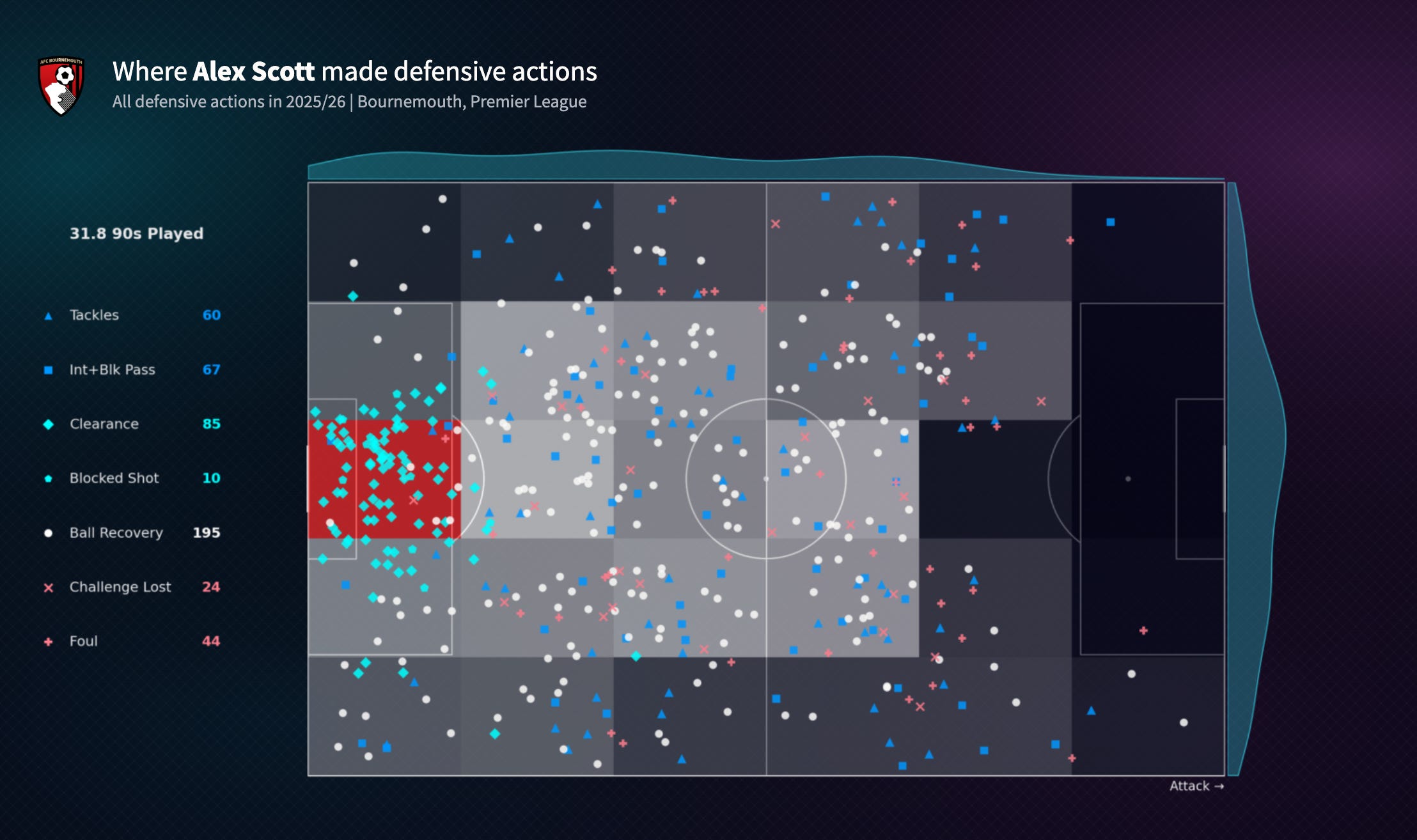
On and off the ball, Scott was an instrumental figure in injecting that intensity and that chaos to Iraola’s midfield last season.
He may not look like the strongest player on the pitch but Scott is tenacious and he times and anticipates his challenges very well.
He averages 8.3 successful defensive actions per 90 minutes last season, ranking him among the top 15 midfielders in the league. He also averaged 5.66 possession adjusted interceptions per 90 minutes - again ranking him among the top 15 midfielders in the league.

Is he worth the money?
So on paper, Scott brings the on the ball qualities of Mac Allister. He’s press-resistant, comfortable in possession and thrives in tight spaces. At the same time, he can provide a lot more intensity off the ball and will work tirelessly - making him more suited to Iraola’s pressing style.
The question however becomes, is he worth £80m? That’s the price tag that is being quoted about for Scott.
It’s a very inflated one. Sure, he’s 22-years-old, homegrown and probably one of the best young English midfielders around maybe minutes Elliot Anderson and Adam Wharton.
But does that really make him an £80m player?
Probably not. He’s closer to a £40m-50m player in today’s market. That doesn’t mean he wouldn’t be a great signing.
Michael Edwards and Richard Hughes are master hagglers so they should be able to get discount if they are serious about bringing the England U21 international to Anfield.
I wonder if Curtis is capable of most of this, given the system and the encouragement to thrive.